TrueNAS H-Serie
Compact and Mission-Critical: 2U, optional HA, hybrid oder All-Flash — NVMe in jeder Bay.
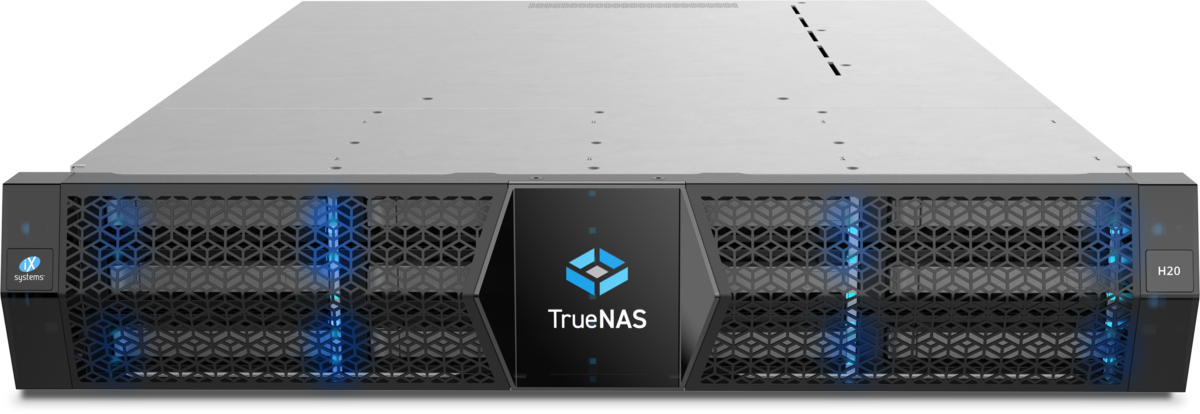
Compact and Mission-Critical
Die H-Serie ist die kompakte Plattform von TrueNAS für Edge-Standorte, kleine Rechenzentren und Filialen. In nur 2U vereint sie 12 Tri-Mode-Bays, optionales Dual-Controller-HA und volle NVMe-Unterstützung — pro Bay individuell wählbar. Damit deckt die H-Serie hybride Pools, reine SAS-Pools und reine All-NVMe-Pools im gleichen Chassis ab.
Die Serie umfasst drei Modelle: H10, H20 und das neue H30 (eingeführt im Januar 2025) — von iXsystems als „Swiss Army Knife of Storage" positioniert. Alle Modelle nutzen die volle TrueNAS-Enterprise-Suite — Snapshots, Replikation, Inline-Komprimierung, Fast Deduplication, RDMA und Truecloud-Backup.
Drei Modelle — eine Plattform
Wählen Sie das H-Modell, das zu Workload und Standort passt — gleicher Form-Faktor, gleiche Software, skalierende Hardware.
Einstieg & Edge
Kompakter Hybrid-Storage für Filialen, Edge-Standorte und kleinere Office-Workloads — mit voller HA-Option.
- • 4 Cores / 8 Threads pro Controller
- • 64 - 128 GB RAM
- • 3,2 TB NVMe Read-Cache
- • 2 GB/s Durchsatz
- • 4× 1 GbE + bis 4× 10/25 GbE
Mittelklasse
Mehr Cores, mehr RAM, doppelter Read-Cache und 100 GbE-Option — für Virtualisierung, Datenbanken und gemischte Pools.
- • 10 Cores / 20 Threads pro Controller
- • 128 - 256 GB RAM
- • 2× 3,2 TB NVMe Read-Cache
- • 4 GB/s Durchsatz
- • Bis 2× 40/100 GbE
Swiss Army Knife of Storage
Das neue Top-Modell der H-Serie. Doppelte Cores gegenüber H20, doppelter Read-Cache und bis zu 1,5 PB All-NVMe in 2U.
- • 20 Cores / 40 Threads pro Controller
- • 256 GB RAM
- • 2× 6,4 TB NVMe Read-Cache
- • 8 GB/s Durchsatz
- • Bis 2× 40/100 GbE, 2× 32 Gb FC
H-Serie selbst konfigurieren
Live-Kapazität, RAID-Layout, Netzwerk und Expansion in wenigen Klicks zusammenstellen — teilbarer Konfig-Code, kein Login, kostenlos.
Konfigurator öffnenTrueNAS H-Serie: Kapazität & Sizing
Wie viel nutzbare Kapazität bleibt nach RAID-Parität und ZFS-Overhead? Typische H-Serie-Konfigurationen als Richtwert — die exakten Zahlen für Ihre Bestückung berechnet der Konfigurator live.
12× 18 TB HDD, RAIDZ2 (1× 12-wide)
Kompakter 2U-Entry, optional HA-fähig.
Mit eigenen Werten durchrechnen12× 22 TB HDD, RAIDZ2 (1× 12-wide)
Mehr Read-Cache und CPU für gemischte Workloads.
Mit eigenen Werten durchrechnen12× 15,36 TB SAS-SSD, RAIDZ2 (1× 12-wide)
Top-of-H als SAS-SSD-Flash mit 100 GbE-Option.
Mit eigenen Werten durchrechnenRichtwerte (TB = 10¹² Byte). Tatsächlich nutzbare Kapazität hängt von vDev-Layout, RAID-Level, Pool-Füllgrad und Datentyp ab. Werte berücksichtigen ZFS-RAIDZ-Padding bei 128 KiB Recordsize / ashift=12 (iX-Quote-konform).
Eigene H-Serie-Konfiguration durchrechnenTrueNAS H-Serie: Spezifikationen im Detail
Vergleich aller Modelle — direkt aus den Konfigurator-Modelldaten generiert (Single Source of Truth).
| Spezifikation | H10 | H20 | H30 |
|---|---|---|---|
| Formfaktor | 2U (681 mm Tiefe) | 2U (681 mm Tiefe) | 2U (681 mm Tiefe) |
| Hochverfügbarkeit (HA) | Optional | Optional | Optional |
| Storage-Modi | Hybrid / All-Flash | Hybrid / All-Flash | Hybrid / All-Flash |
| CPU (Cores / Threads) | 4 Cores / 8 Threads | 10 Cores / 20 Threads | 20 Cores / 40 Threads |
| RAM (max.) | 64–128 GB | 128–256 GB | 256 GB |
| Laufwerks-Bays | 12× 3.5" (front) Tri-Mode | 12× 3.5" (front) Tri-Mode | 12× 3.5" (front) Tri-Mode |
| Read-Cache | 3,2 TB NVMe SSD | 2× 3,2 TB NVMe SSD | 2× 6,4 TB NVMe SSD |
| Write-Cache | NVMe SSD Write Cache | NVMe SSD Write Cache | 2× NVMe SSD Write Cache |
| Max. Kapazität (roh) | 1,8 PB | 3,0 PB | 3,0 PB |
| Max. Drives | 72 | 114 | 114 |
| Max. Durchsatz | 2 GB/s | 4 GB/s | 8 GB/s |
| Fibre Channel | 2× 16Gb | 2× 16Gb | 2× 32Gb |
| Netzwerk (max.) | 4× 1GBase-T (onboard) · Bis 4× wählbar 10 / 25 GbE (optional) | 4× 1GBase-T (onboard) · Bis 4× wählbar 10 / 25 GbE (optional) | 4× 1GBase-T (onboard) · 2× 10GBase-T (onboard) · Bis 4× wählbar 10 / 25 / 40 / 100 GbE (optional) |
| Management | 1× IPMI Out-of-Band Management | 1× IPMI Out-of-Band Management | 1× IPMI Out-of-Band Management |
| Erweiterungs-Shelves | 1× ES24 | 1× ES60 (max 1 gesamt) | 1× ES24 | 1× ES60 | 1× ES102 (max 1 gesamt) | 1× ES24 | 1× ES60 | 1× ES102 (max 1 gesamt) |
| Leistung (typ.) | 200 W | 300 W | 400 W |
| Leistung (Spitze, HA) | 380 W | 520 W | 680 W |
| Wärmeabgabe (HA) | 1.100 BTU/h | 1.600 BTU/h | 2.150 BTU/h |
| Eingangs-Spannung | 100–240 V auto | 100–240 V auto | 100–240 V auto |
| Redundante Netzteile | Ja | Ja | Ja |
| Maße (L×B×H) | 681 × 483 × 89 mm | 681 × 483 × 89 mm | 681 × 483 × 89 mm |
| Gewicht | 19,5 kg leer / 30,4 kg voll | 19,5 kg leer / 30,4 kg voll | 19,5 kg leer / 30,4 kg voll |
| Betriebstemperatur | 0–40 °C | 0–40 °C | 0–40 °C |
| Luftfeuchte | 8–80 % | 8–80 % | 8–80 % |
| Zertifizierungen | RoHS 6/6, CE, FCC Class A, VCCI, UL, BSMI | RoHS 6/6, CE, FCC Class A, VCCI, UL, BSMI | RoHS 6/6, CE, FCC Class A, VCCI, UL, BSMI |
Architektur und Erweiterung
Das 2U-Chassis kombiniert Tri-Mode-Bays mit optionalem HA und 100-GbE-Optionen — bei kompaktem Form-Faktor.
12 Tri-Mode-Bays
Jede der 12 Hot-Swap-Bays unterstützt SAS-HDD (8-26 TB), SAS-SSD (1,9-15,36 TB) oder NVMe-SSD (3,8-61,4 TB) — pro Bay individuell wählbar.
Dual-Controller-HA optional
Alle drei Modelle sind optional mit Dual-Controller-HA verfügbar — Failover ohne Datenverlust und mit Virtual-IP-Migration.
100 GbE-fähig (H20/H30)
H20 und H30 unterstützen 2× 40/100 GbE oder 4× 10/25 GbE — ausreichend Bandbreite für Virtualisierung und VDI.
Bis 1,5 PB All-NVMe in 2U (H30)
Als All-NVMe skaliert das H30 mit Erweiterungs-Shelves bis zu 1,5 PB Flash-Kapazität (roh) — ideal für AI-Inference an der Edge.
Verfügbare Storage-Medien
Alle Medien werden mit voller TrueNAS-Enterprise-Integration ausgeliefert — inklusive Hardware-AES-NI-Verschlüsselung, S.M.A.R.T.-Monitoring und Hot-Swap-Unterstützung.
Enterprise Nearline HDDs
- • 7200 RPM SAS3
- • 8 TB bis 26 TB pro HDD
- • Optional SED und FIPS 140
SAS SSDs
- • 1,9 TB bis 15,36 TB pro SSD
- • Optional SED und FIPS 140
NVMe SSDs
- • 3,8 TB bis 61,4 TB pro SSD
- • Optional SED und FIPS 140
- • Frei mit SAS-Medien mischbar pro Bay
Strom, Klima, Maße
Redundante 80-Plus-Platinum-Netzteile (Auto-Switching 100-240 V) mit Hot-Swap. Ferngesteuertes Power-On/Off via IPMI und UPS-Signal-Integration sind Standard.
Protokolle und Integration
Volle TrueNAS-Enterprise-Suite — File, Block und Object in einem System. Tiefe Integration in Hypervisor- und Cloud-Stacks.
File-Protokolle
- • SMB v1/2/3
- • NFSv3, NFSv4 mit RDMA
- • FTP, WebShare
Block-Protokolle
- • iSCSI, RDMA via iSER
- • NVMe-oF (TCP/RDMA)
- • Fibre Channel
- • OpenStack Cinder
Object & Verzeichnisdienste
- • S3-compliant + Immutable Locking
- • MinIO Alstor
- • Active Directory, FreeIPA
- • Kerberos, LDAP, NIS
Hypervisor & Apps
- • VMware (VAAI, vCenter, VM Warn/Stun)
- • Proxmox-Plugin (iSCSI + Snapshots)
- • Hyper-V (VSS, ODX, CSV)
- • KVM, XenServer, OpenShift
- • Kubernetes CSI
Wofür ist die H-Serie gemacht?
Workloads, die kompakte Bauform, optionales HA und flexible Medien-Wahl verlangen.
Edge-Standorte & Filialen
Kompakter 2U-Storage für verteilte Standorte mit zentralem Management, ZFS-Replikation und optionalem HA.
Kleine Virtualisierungs-Umgebungen
iSCSI- und NFS-Storage für VMware-, Proxmox- und Hyper-V-Cluster mit 10-100 VMs — mit Snapshot-Integration und HA.
Video-Surveillance
Hybrid-Pools mit großen HDDs als Aufzeichnungs-Target. Skalierbar auf bis zu 3 PB roh über ein ES60- oder ES102-Shelf.
VM-Hosting für Office
Zentraler Storage für Datei-, Mail- und Datenbank-VMs in KMU. Inline-Komprimierung und Snapshots inklusive.
Backup-Targets für KMU
Hochkapazitives Backup-Ziel für Veeam, Asigra, CommVault und Truecloud-Backup zu Storj — mit Immutable Snapshots gegen Ransomware.
All-NVMe in 2U für AI-Inference
Bis zu 1,5 PB All-NVMe (H30) für GPU-Inferenz-Knoten, Medizin-PACS oder Echtzeit-Analytics — mit NVMe-oF zu Compute-Nodes.
Sicherheit und Compliance
Die H-Serie nutzt die TrueSecure-Funktionen der TrueNAS-Enterprise-Suite — von hardware-beschleunigter Verschlüsselung bis zu auditierten Admin-Rollen.
Backup und Cloud-Integration
Die H-Serie integriert sich nahtlos in bestehende Backup- und Cloud-Strategien — als primäres Storage-Tier ebenso wie als Replikations-Ziel.
Ihre Vorteile mit DATAZONE
Als TrueNAS-Partner begleiten wir Sie durch den gesamten Lebenszyklus der H-Serie — von der Auslegung über die Inbetriebnahme bis zum laufenden Betrieb. Wir sind herstellerneutral und konfigurieren das System ausschließlich nach Ihren tatsächlichen Anforderungen.
Passt die H-Serie zu Ihnen?
Die H-Serie ist die richtige Wahl, wenn mindestens einer dieser Punkte zutrifft:
- → Speicherbedarf unter 3 PB roh
- → Edge-Standort oder Filiale mit begrenztem Rack-Platz
- → Optionales HA gewünscht — ohne 4U-Footprint
- → Kompakte 2U-Bauform Pflicht
- → Gemischte Workloads, aber mit NVMe-Option pro Bay
Bei mehr als 3 PB, 100 GbE+ oder 99,999 % Uptime-Anforderung ist die V- oder M-Serie oft passender — wir beraten Sie offen.
Häufige Fragen
Was ist die TrueNAS H-Serie?
Welche Modelle umfasst die H-Serie?
Was bedeutet Tri-Mode bei der H-Serie?
Wann lohnt sich H30 statt V160?
Welche Netzwerk-Optionen gibt es?
Wie hoch ist der Stromverbrauch?
Welche Erweiterungs-Shelves sind möglich?
Welche Protokolle und Hypervisor werden unterstützt?
TrueNAS H-Serie evaluieren
Wir beraten Sie zur passenden Konfiguration (H10, H20 oder das neue H30), zum Hybrid- vs. All-NVMe-Layout und zur Integration in Ihre bestehende Infrastruktur.
Jetzt Kontakt aufnehmen