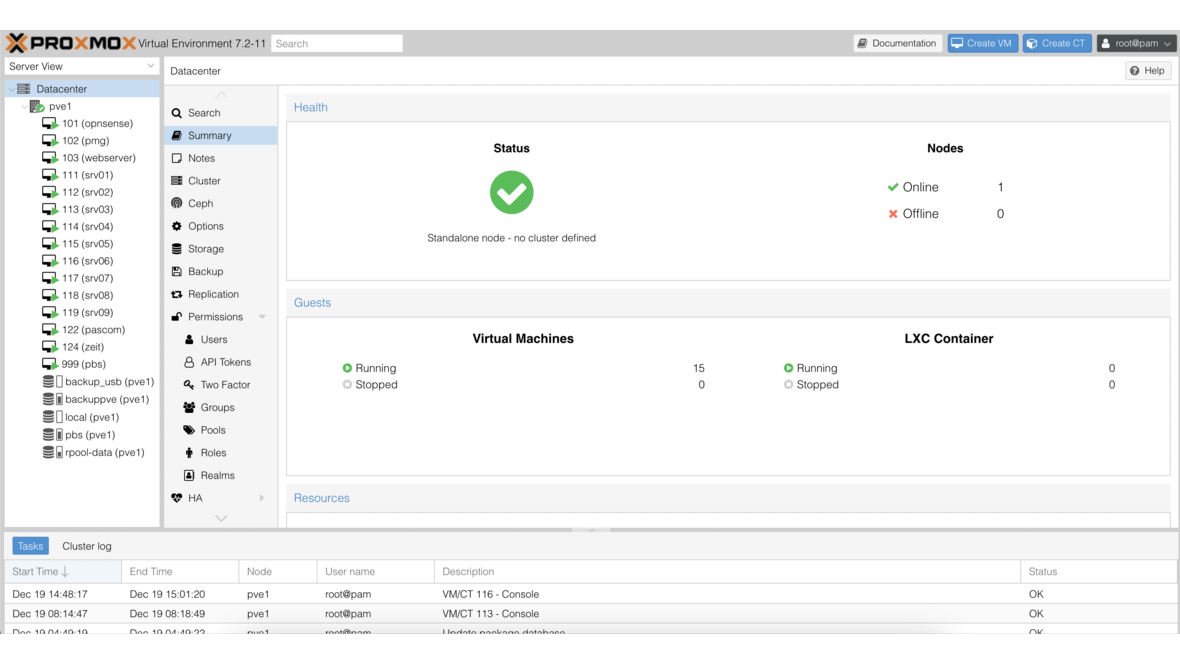
Proxmox has released Proxmox Virtual Environment 7.0 — a major release based on Debian 11 “Bullseye” that brings numerous fundamental new features. This release marks the transition to a modern system foundation with a current kernel and updated virtualization technologies.
The Most Important New Features
Debian 11 Bullseye as the Foundation
Proxmox VE 7.0 uses Debian 11 “Bullseye” as its base for the first time. This brings a multitude of updated system libraries, improved security standards, and long-term support. The switch to Debian 11 provides a future-proof foundation.
Linux Kernel 5.11
The updated Linux Kernel 5.11 offers:
- Improved hardware support for current server platforms
- Optimized performance for I/O-intensive workloads
- New drivers for current network and storage controllers
- Improved support for the latest generation AMD EPYC and Intel Xeon processors
QEMU 6.0
With QEMU 6.0, numerous improvements come to VM virtualization:
- Improved live migration with reduced downtime
- Updated device emulations
- Optimized I/O performance
- New virtual hardware options
Ceph Pacific
The integrated Ceph version has been updated to Ceph Pacific (16.2):
- Significantly improved performance
- New Ceph dashboard
- Optimized erasure coding support
- Improved monitoring and alerting
LXC 4.0
The container technology has been updated to LXC 4.0 and offers improved security features as well as optimized resource management.
ZFS 2.0
OpenZFS 2.0 brings important new features:
- Persistent L2ARC — the L2ARC cache now survives reboots
- Sequential Resilver — faster recovery during drive failures
- Improved performance with small block sizes
- Optimized memory management
Web Interface
The web interface has been further modernized:
- Redesigned layout with improved user guidance
- Updated ExtJS framework
- Improved Ceph management interface
- Optimized monitoring dashboard
- Extended backup management
Upgrade from Proxmox VE 6.x
An in-place upgrade from Proxmox VE 6.4 to 7.0 is possible. Proxmox provides a detailed upgrade guide. It is strongly recommended to perform a complete backup of all virtual machines and containers before the upgrade and to carefully work through the upgrade checklist.
Conclusion
Proxmox VE 7.0 is a significant major release that offers a powerful and future-proof platform with Debian 11 as its base, OpenZFS 2.0, and Ceph Pacific. As a certified Proxmox partner, we are happy to assist you with the migration and operation of your Proxmox infrastructure.
More on these topics:
More articles
ZFS vs. Btrfs vs. ext4: Which Linux Filesystem for Which Job in 2026?
ZFS vs Btrfs vs ext4 — an honest 2026 comparison: features, maturity, snapshots, send/receive, encryption, and where ext4 is still the right choice.
Proxmox for Beginners: Your First VM in 30 Minutes
Proxmox beginner guide: install the ISO, set up the network bridge, create your first VM, use Cloud-Init and plan a backup — no prior knowledge, done in 30 minutes.
The Cloud Is Not a Backup: On-Premises TrueNAS as Your Resilient Extra Layer
After destroyed data centers, even AWS pointed customers to their own backups. Why an on-premises backup layer with TrueNAS (immutable ZFS snapshots, pull replication, air-gap) is a mandatory part of any data strategy.